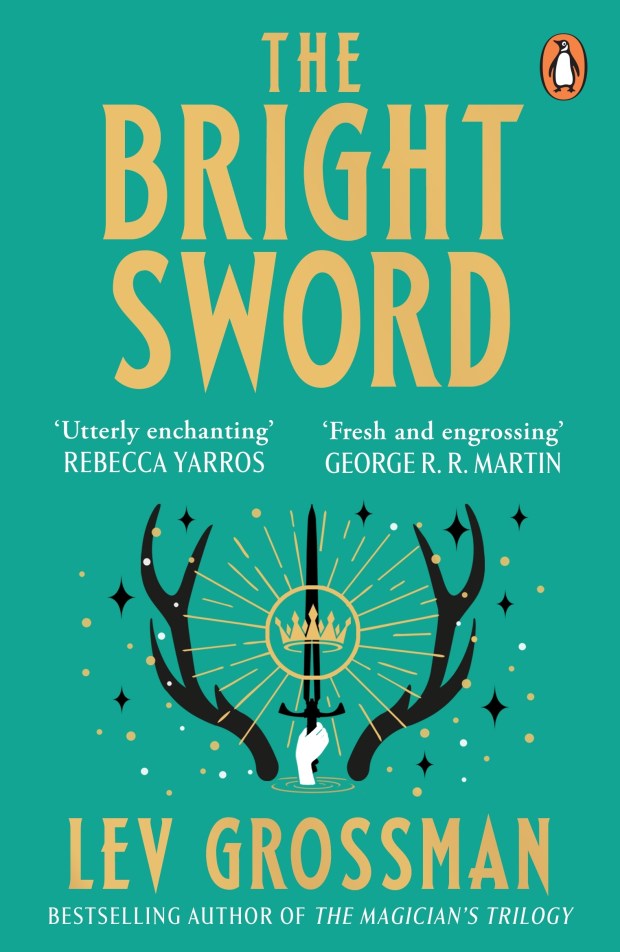
On very rare occasions a friend will describe a particular facet of a book they’re reading that awakens not just interest but a deep need in me. This was the case when my friend Marita Arvaniti described the characterization of Sir Bedivere in Lev Grossman’s The Bright Sword (2024), a novel that follows the grieving remnants of the Round Table after the fall of King Arthur. The thought of a gay Sir Bedivere with an unrealized love for Arthur, and where that might take him after the fall of the Round Table, took hold and would not let me go. It seemed particularly to chime with the way Alfred, Lord Tennyson’s iteration of the Arthurian tradition in Idylls of the King (1885) lingers on Bedivere as he tends to the mortally wounded Arthur and bears witness to his departure for Avalon, a move that I have always read as an outgrowth of Tennyson’s grief for the Arthur in his own life, his companion Arthur Henry Hallam. As it turned out, The Bright Sword proved a fascinating and rare case study of two very different approaches to representing queerness in modern fantasy within the same text through Bedivere and Sir Dinadan.
There has always been something queer about my interest in Arthuriana, ever since my ninth-grade English teacher, Mrs. Lyon, gave me a spare translation of Sir Thomas Malory’s Le Morte d’Arthur (c. 1470) that she had lying around for help with a school project. (I proceeded to read the whole thing in about a month, which probably wasn’t her intention.) Initially drawn to the Arthurian tradition because of its influence of the fantasy literature I loved, I was struck by its sense of tragedy and melancholy in the context of a close homosocial brotherhood of knights. Jes Battis has identified a symmetry between the ‘narratives based on loss, lack, and misrecognition’ (2007: 3) that characterize medievalist fantasy literature and its source or ‘taproot’ texts, and the melancholy that structures queer life: longing for what is lost, for what cannot be, for what is forbidden. In a context in which I could not view or address my own queerness directly, Camelot and its fall became a way of accessing my desire for closeness with other men and mourning for its lack. Grossman’s address of the queer melancholy that Arthuriana evokes on a textual level has precedent within the tradition, most notably in T. H. White’s exploration of queer self-loathing through his bisexual Lancelot in The Once and Future King (1958).
Grossman’s Bedivere shares the role that he has at the end of Malory’s, Tennyson’s, and White’s versions of the story, but he is also the first knight to pledge himself to the newly crowned king. Upon arriving in Londinium, where knights have travelled from all over Britain to take part in a tournament and try their hands at pulling the sword from the stone that will decide the next king, the young Bedivere blows off the tournament to cruise for casual sex with other men. After a cruising encounter ends disastrously, with the other man trying to mug Bedivere and Bedivere killing him in self-defense, he returns to St Paul’s Cathedral just as young Arthur pulls the sword from the stone and is hailed as King of Britain. Wracked with shame and self-disgust, he embraces service to Arthur as a role that might sanctify his existence in a world that seems to hold no place for him otherwise:
‘This Arthur had in him a spark, a guttering flame, and Bedivere would feed it and protect it till it lit up the whole world. His life meant little to him, but he could make of it a gift for a king, and that was something.’ (69)
Bedivere becomes, for the entirety of Arthur’s rule, his trusted friend and confidant, a position that confers no prestige but with which Bedivere wills himself to be content. The narration outlines that
‘[h]e wasn’t Arthur’s counselor — that was Merlin — and he would never be his champion-at-arms — that was Lancelot. But he was Arthur’s best friend and bodyguard, good-humored and level-headed and utterly trustworthy. […] He made it his business to be the only person in Britain who asked nothing from Arthur other than that he stay alive and on the throne.’ (70)
Bedivere’s insistence on serving Arthur in the most unobtrusive way possible, however, is itself an outgrowth of his latent (and ultimately unrequited) infatuation with Arthur, both fuelled and complicated by the inscrutable face Arthur presents to everyone at court. As a textual figure of legend, Arthur has always been an enigma, a bundle of contradictions: simultaneously a monarchist myth of the good king and a man who genuinely desires justice; a symbol of British Christian nationalism shot through with distinctly un-Christian fairy magic; a paragon of the best of humanity and an embodiment of the impossibility of moral perfection. Grossman’s elevation of the incoherences at the centre of Arthur to the level of characterization is a neat manoeuvre that in many ways extends T. H. White’s interpretation of the tragedy of Camelot as a parable about the impossibility of a just monarchy. Bedivere’s misgivings about Arthur’s reign grow alongside his affection for Arthur as a person. In one flashback, after a feast, a drunken Arthur confesses to Bedivere the original sins that led to his rule — the rape of Igraine and Merlin’s complicity in it — and his fears that all his own striving for moral goodness will never justify his occupation of the throne. Arthur then falls asleep, and
‘[f]or once Bedivere felt free to study his beloved as much as he liked. Asleep, the king looked childlike and at the same time older than his years, all stubble and clogged pores and broken veins. Gazing at him Bedivere felt for a moment every bit the prophet that Merlin was. He could see it all, past, present, and future, and what he saw made him afraid.’ (85)
These flashbacks make clear that Bedivere’s story is one of a man who deludes himself, despite what he knows, that his duty to Arthur will sanctify his desire in a world that cannot tolerate it, and is bereft when he can no longer fulfil that duty. The middle-aged Bedivere we meet in the novel’s present is barely holding it together, drinking heavily to numb his grief over his lost love and his despair at a world that stubbornly continues to exist despite it all. Rarely in fiction, and even more rarely in genre fiction, are we invited to sit with an older gay man’s frustrated desires and grief, and The Bright Sword‘s willingness to do so with Bedivere makes it noteworthy. The flashback chapters detailing his closeness with and unrequited desire for the king, juxtaposed with a present in which Bedivere has already lost Arthur, are so wrenchingly sad that at times I had to put the book down and walk several paces around the room before resuming reading. (To be clear, for anyone who doesn’t know me well, I mean this as a compliment.) Here’s a brief sampling:
‘Seeing the king’s face in the starlight, so glad and so troubled at the same time, Bedivere fell in love with him all over again. According to the priests, sex between men was a sin because it was not in the interest of reproduction, because it wasted the man’s seed. But what about the waste of love? Was that not a sin too?
‘As the desert bloomed around them Bedivere’s love for Arthur hurled itself against the walls of his heart, battered at them, trying to get out, again and again, until finally it fell back exhausted and bloody. It would die inside him, alone and starving. He would never bloom.’ (119)
While Bedivere makes do with casual hookups with other knights, Arthur remains his one true love whom he cannot have, and this fact informs many of his actions in complex ways throughout the novel. His eventual reconciliation with Guinevere, born out of mutual recognition of each other’s love for Arthur, is uneasy and hard-earned. A much later flashback chapter from Arthur’s perspective reveals that ‘Arthur saw the love in Bedivere, though he couldn’t return it, not in kind. It was their Gordian knot, and they could neither solve it nor cleave it in two’ (610). Here, then, is an intimate portrait of a queer life as it might exist in the medieval Britain of the novel’s setting: messy and fraught with heartache, but a life nonetheless, in all its multifaceted glory.
The Bright Sword paints its other queer Knight of the Round Table, Sir Dinadan, in considerably broader strokes. Assigned female at birth, the child Dinadan is plagued by a growing conviction that he is a boy and a jealousy of his twin brother’s training in swordsmanship, while Dinadan is schooled at a neighbouring convent. What follows is a fairly rote story of trans self-actualization: at a loss for how to realize a life as a man, Dinadan summons a fairy who, in lieu of physical transition, leads him to a secret place under a lake where Dinadan can train in swordsmanship by night. Upon reaching adulthood, he spurns a political marriage in favour of a life at Camelot as a Knight of the Round Table. And … that’s about it. Aside from his flashback chapter and the novel’s climax and conclusion, he mostly recedes into the background of the narrative, just one of the company of knights questing throughout the novel. Even an early scene hinting at Dinadan’s transness, in which he refuses to bathe with the other knights, is so boilerplate that it calls to mind near-identical scenes from Barbra Streisand’s Yentl (1983) and Disney’s Mulan (1998). Later, when he does bathe with Sir Collum and Sir Palomides, the only reaction from the other knights is disinterested affirmation, whereas the most insight we get into Dinadan’s feelings about the situation is that ‘[h]e was letting Collum in on something, on purpose, but he was still wary’ (569).
Beyond the bare fact of his transness, Sir Dinadan is a blank; even his chosen name is something of an afterthought, by his own admission. (‘It could be anything,’ he reflects. ‘Sir Ringading. Sir Falala’ (281)). Who is this person? What does he value and desire beyond, in addition to, transition? Dinadan longs to be a knight, but we get little insight into what draws him to knighthood, specifically, aside from its masculine trappings. In the novel’s present, Dinadan is a skilled fighter with an unconventional duelling technique learned from his fairy swordmaster, but these external attributes tell us little about him. We are told, repeatedly, that he is renowned throughout Camelot for his wit, but a couple of throwaway potshots at Sir Dagonet are the extent to which this comes into play in almost 700 pages of text. The most interesting thing the text does with Dinadan is locate his transness in the tradition of crossdressing Christian saints of late antiquity and the early Middle Ages. But even this comes off as a defensive manoeuvre against bad-faith claims of anachronism rather than emerging organically from the character, given Dinadan’s apparent lack of interest in matters of religious devotion and the fact that it never comes up again. In an otherwise theologically rich novel fraught with questions about the will and nature of God, this is conspicuous.
By now it’s probably obvious that I find one of these characters significantly more compelling than the other, and here I must acknowledge that it happens to be the character with whom I share the most in common, both experientially and from an identitarian standpoint as a cisgender gay man. However, my reading of these two very different presentations of queerness in The Bright Sword is less about what personally resonates for me than about who gets to be a flawed and nuanced individual and who is asked to be a flat stand-in for an entire identity group. Bedivere’s feelings about his gay desires remain unresolved at the novel’s conclusion; he swings wildly between reckless pursuit of them and weary resignation to his loneliness, between self-justification and self-loathing. He is tender-hearted and loyal to Arthur to the point of rigidity, and this leads him to misjudge other characters, Guinevere chief among them. Dinadan, meanwhile … is trans. Readers of Queering Faith in Fantasy Literature will know that my issues with Dinadan are comparable to my criticism of the character of Eolo in Ann Leckie’s The Raven Tower (2019); in both cases, the text feels so scrupulously concerned with avoiding offense in its presentation of a trans character that it forgets to invest them with any kind of interiority or distinctive outlook. (Leckie’s novel gets away with this slightly better by virtue of the fact that all of the human characters are deliberately presented at a chilly remove, but only slightly.)
This gravitation toward the general over the particular is symptomatic of a broader trend in how modern genre fiction approaches a variety of marginalized identities, epitomized by the slogan ‘representation matters’. The thinking here goes that the most important strategy for correcting a historical lack of diversity in science fiction and fantasy is to ensure that readers see their own identities reflected in the fiction they read. My current long-term writing project includes a longer and more in-depth critique of this line of thought, but in brief: the problem here is not the desire for diversity itself (otherwise I wouldn’t be writing this blog post). The problem (or one of them) is that modern genre fiction and criticism tend to reduce the lived experiences of diverse readers down to abstracted markers of identity, an approach that, to quote Samuel R. Delany, ‘tends to assume that the individual’s subjective field is one with the field of social statistics’ (1999: 74). In Andrea Long Chu’s words, it is ‘to respond to pigeonholing by overstating the value of being a pigeon’ (2025: 255). Fictional characters start to be evaluated based on how well they ‘represent’ the various identity categories they inhabit — which is another way of saying how well they can serve as model minorities, as emblems who can be both flattering to a reader who shares a given character’s marginalized identities and educational to readers who do not.
Approaching queerness as an identity that can be generically represented is especially problematic because it removes the animating engines of queerness — desire, the forces that shape it, and the tensions that emerge from its pursuit — from the equation. As C. L. Clark argues, ‘[i]nstead of stopping at the generalization of a character’s type, we must imbue them with unique personalities driven by the specifics of their world–enough personality to be disliked by some, enough honesty to admit their desires, and enough humanity to make mistakes in the attempt to reach them’. Grossman clearly understands this, because he achieves it beautifully with Bedivere, and it is frustratingly telling that he does not afford the same level of nuance to characters who are not cis men. His Lancelot is driven to religious fanaticism by his longing to recapture the unity with God he feels when performing divine miracles and his anxiety that he can never earn God’s love; meanwhile, Grossman seems unable or unwilling to imagine a Guinevere who has sympathetic motivations for cheating on her husband, resulting in one of the novel’s biggest departures from other iterations on the Arthurian tradition. (‘Let Guinevere fuck!’ exclaimed my friend when we were discussing the novel.) Even the debt the fairies demand of Dinadan in exchange for his training, that he kill Merlin, is robbed of any narrative friction by the fact that Grossman’s Merlin is an irredeemable villain: power-grubbing, opportunistic, and sexually predatory.
With Bedivere, the reader is offered insight into a person’s complex psychology surrounding his own desires, and how that shapes his behaviour. By contrast, passages such as the following, when Dinadan as a child glimpses his reflection wearing boys’ clothes for the first time, evoke nothing so much as the author patting himself on the back:
‘He felt real, realer that she did, as if she were the rippling insubstantial reflection and he the real thing. She knew at that moment that she didn’t want to be insubstantial anymore, she wanted to be real. She wanted to be that boy. No, she already was him–that boy was who she’d always been. She was he.’ (262)
There’s nothing wrong here, per se, but it lacks a certain lived-in quality that Bedivere’s chapters possess in spades. It hits the obvious beats of this kind of coming-out story and nothing more, and hits them with such blunt force as if to directly say to a trans reader, ‘Do you feel represented now?’ It’s a bit patronizing, especially in a literary landscape populated by excellent novels by trans authors interested in facets of trans lives other than coming out. (Go read Dead Collections (2022) by Isaac Fellman. Or, if you want to see the type of trans self-realization that Grossman attempts here done well in a fantasy context, read The Sapling Cage (2024) by Margaret Killjoy.)
Arguably, The Bright Sword ends up falling short even of the goal not to offend by the conclusion of Dinadan’s story. Throughout the novel, the witch Nimue continually reminds the other characters of the prophecy that Merlin can only be killed by a man. Naturally, it is Dinadan who deals the finishing blow to the wizard, thereby both fulfilling his debt to the fairies for his training as a swordsman and proving, once and for all, the metaphysical reality of his manhood. But before this occurs Dinadan is first stripped naked, forcibly outed, ridiculed, and misgendered by Merlin and his new liege, Lancelot, who takes the throne of Camelot seeking to remake Britain as a rigid theocracy. One might expect anyone to be, at the very least, rattled by such a humiliation ritual. Not so with Dinadan, who remarks that he ‘almost feel[s] like [he] owe[s] those sons of bitches’, that he’d ‘kept the secret too long’, and that ‘the best thing [Lancelot] ever did’ was out him (657).
This dialogue betrays a stunningly naïve misunderstanding, on the novel’s part, of the complexities of being ‘out’ as a trans person that is especially ill-suited to the political realities of the 2020s. In particular, Dinadan’s sense of obligation sits uncomfortably alongside the immediate context of the novel’s publication in the United States, where already in 2024 multiple states had introduced bills mandating genital inspections for trans people, including children. It confuses the choice to be visibly trans as an act of self-determination with the experience of exposure as a condition of surveillance and scrutiny. Even at best, Dinadan’s nonchalance about the latter renders this instance of trans representation a power fantasy that sidesteps the difficult human emotions that would make such representation resonant in the first place.
I am very, very far from hating The Bright Sword. Grossman has a lot of interesting things to say about the phenomenon of Arthur and the story he tells about Britain’s self-identity and who it includes, and his perspective is especially provocative on the subject of religion. On the whole, I enjoyed reading it and reigniting my interest in Arthuriana. But queer lives do not exist to be pat object lessons for straight cis people, and the older I get the less patience I have for representations that seek merely to validate and explain our own identities back to us. Fantasy literature and its attendant fan cultures and institutions often implicitly presume that a queer reader is someone coming to an understanding of their desires and self-determination for the first time, who looks to the text to affirm that process. They seem to have a harder time imagining readers like me and most other queer people I know: people coming to the text in the middle of life, with established relationships to queer cultures and communities outside of genre fandom. Bedivere, as rendered by Grossman, speaks to the inherent messiness of queer life in a way that is genuinely refreshing and deeply poignant. Dinadan, meanwhile, cannot seem to escape the confines of a textual world in which cis men can be anything, and everyone else is ‘representation’.
Works cited
Battis, Jes. ‘Queer Spellings: Magic and Melancholy in Fantasy-Fiction’ (unpublished doctoral thesis, Simon Fraser University, 2007).
Chu, Andrea Long. ‘You Must Decide’, in Authority: Essays on Being Right (London: Penguin Random House, 2025), 250-256.
Clark, C. L. ‘Everyone’s in Love, but Nobody’s Horny’, Reactor, 30 September 2025. <https://reactormag.com/everyones-in-love-but-nobodys-horny/> [accessed 10 September 2026].
Delany, Samuel R. ‘Coming/Out’, in Shorter Views: Queer Thoughts and the Politics of the Paraliterary (Hanover, CT and London: Wesleyan University Press, 1999), 67-97.
Grossman, Lev. The Bright Sword (London: Penguin Random House, 2025).

